INBRE Fellowship

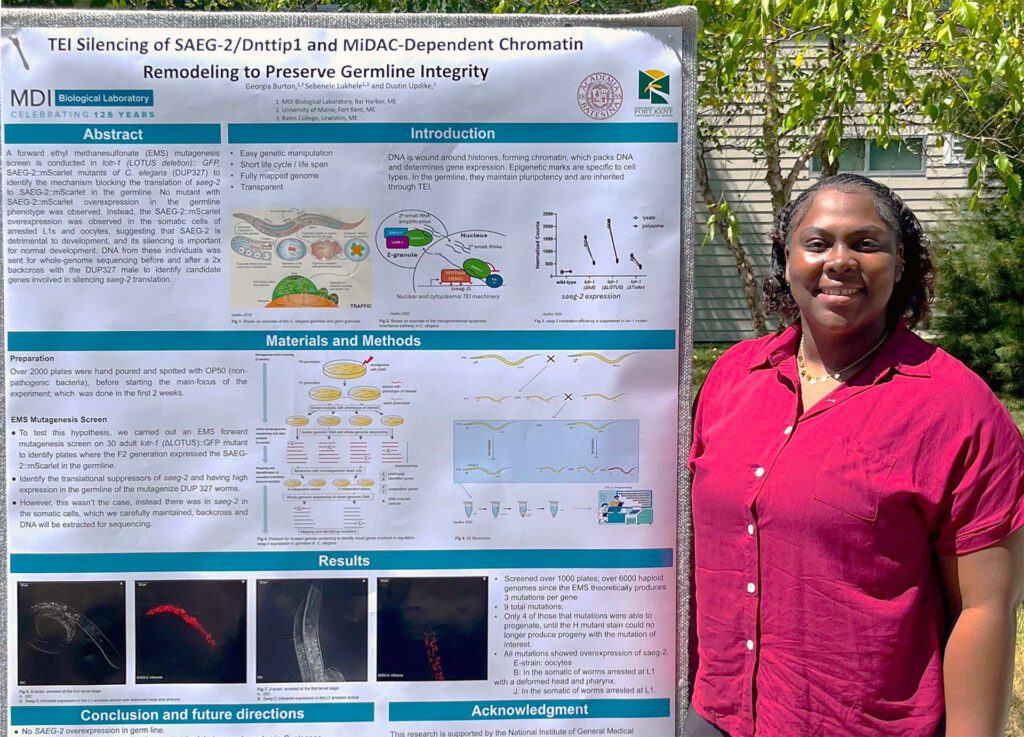
UMFK biology student Georgia Burton poses next to her research poster
Georgia Burton, a UMFK biology student, participated in the INBRE fellowship this past summer. The University receives one fellowship opportunity each year. Through a thorough selection process, applications are reviewed and evaluated by a committee of faculty and staff from MDIBL and institutions across the state prior to final selection. The student who is selected is typically placed at one of their top three choices for summer research at a host institution in Maine.

Georgia Burton is making the most of her opportunities at the University of Maine at Fort Kent (UMFK) as she pursues her ultimate dream of earning a doctorate in physical therapy.

The Westmoreland, Jamaica native is in her senior year at UMFK, where she expects to complete her Bachelor of Science in Biology (biology/medical concentration) in May 2026. In addition to her academics, where she currently has a 3.74 GPA, Burton serves as president of the International Student Organization and is the Student Athletic Advisory Committee’s Track and Field Women’s representative. Her events in track and field include discus, shot put, hammer, and javelin.

For ten weeks this past summer, Burton was one of 25 students from among Maine’s public and private colleges and universities selected to participate in the Maine IDeA Network of Biomedical Research Excellence (INBRE) Summer Research Fellowship program at the Mount Desert Island Biological Laboratory (MDIBL) in Bar Harbor.

Maine INBRE is funded by an Institutional Development Award (IDeA) from the National Institute of General Medical Sciences of the National Institutes of Health.

The summer fellowship program provides undergraduate students with a mentored, hands-on biomedical research experience at one of the participating network institutions as part of broader Maine INBRE’s goal of building a biomedical workforce and making Maine more competitive for research grants. Students work in the laboratory of an investigator on an independent project designed by the student and their mentor. Students can develop laboratory techniques in molecular biology, physiology, and bioinformatics. Projects focus on a research question in functional genomics and use a variety of comparative models such as zebrafish, fruit flies, axolotl, and C. elegans.

Burton learned of the Fellowship opportunity from Samantha Beaulieu, the natural sciences laboratory manager at UMFK. In that capacity, Beaulieu also serves as the principal investigator for the grant that supports UMFK’s participation in the Maine INBRE.

“I promote these opportunities here on campus, so students are aware and encouraged to apply,” said Beaulieu. “I help match students with science-specific opportunities, sometimes involving individual faculty members who have individually applied for their own grants through various external funding sources.”

Dustin Updike, Ph.D., is the director of the Developmental Research Project program at MDIBL. It was under his preceptorship and within his laboratory where Burton conducted her research.

“We were incredibly fortunate to have Georgia join our lab this summer,” said Updike. “Georgia arrived well-prepared and eager to learn. Her project focused on identifying the gene products that keep a novel histone deacetylase (HDAC) complex turned off in the germline—the cells that give rise to sperm and eggs. HDAC complexes are known to compact DNA; however, little is understood about this newly identified complex beyond its essential role in late mammalian embryonic development.

“Instead of working with mammals directly, Georgia studied the equivalent complex in the nematode Caenorhabditis elegans. These tiny roundworms have long served as powerful models for human genetics, as they share roughly the same number of genes as humans, with many nearly identical to their human counterparts, but have a short generation time of four days,” Updike explained.

Burton’s work was truly a tour de force. Over the course of the summer, she carefully examined more than a thousand petri dishes—each containing over a thousand nematodes. Under the microscope, she searched for the rare one or two animals on each plate in which the HDAC complex became activated. Through this meticulous effort, she identified animals with candidate genes that may be responsible for keeping the complex turned off.

“It was an immense amount of work and, at the same time, a crash course in genetics. What Georgia accomplished in the ten weeks was nothing short of remarkable. She seemed to be having fun at it, too,” Updike added.

If Updike was impressed with Burton’s eagerness to learn, she certainly speaks effusively of her MDIBL summer experience.

“This past summer, I worked in Dr. Updike’s lab, where I used Caenorhabditis elegans to study transgenerational genetic inheritance. My gene of interest was saeg-2, which is a fascinating gene with a human counterpart known as Deoxynucleotidyl transferase Terminal Interacting Protein 1 (DNTTIP 1), a protein-coding gene,” Burton noted.

“DNTTIP1 is involved in several cellular processes, including DNA synthesis, gene expression regulation, and cell cycle control, making it an important link between basic research and potential human health applications.

“I also had the opportunity to perform EMS mutagenesis for the first time, a challenging but exciting technique, which led to promising results. I even conducted DNA extractions that will be sent for full genome sequencing, an important step toward uncovering new insights into this gene’s role,” Burton mentioned.

If all work and no play make for a dull life, Burton and her lab colleagues made the best of their time after hours, as well.

Ready access to Acadia National Park afforded many after-hours hikes. And while the Atlantic proved to be a bit too cold, there were a few inland lakes that offered some invigorating swims and nighttime bonfires.

Burton’s classmates represented a cross-section of Maine’s higher education institutions, as well as states as varied as North Carolina and Oregon, and foreign countries near (Canada) and far (Swaziland). Among their commonalities for ten weeks this past summer was shared genetic research and an appreciation of the natural beauty of Maine.

“My being awarded an INBRE Fellowship was an incredible honor, and it was a privilege to spend the summer surrounded by brilliant scientists, inspiring mentors, and a community passionate about discovery,” said Burton.

“This was an amazing opportunity to gain valuable laboratory experience and use state-of-the-art equipment, beyond what is typically available at UMFK.

“I was able to conduct DNA research, hear from a variety of researchers and guest speakers, and gain a lot of insight from my talks with Ph.D. students who participated in the program. I came away with a greater understanding of what to expect for my graduate degree program, and I had the opportunity to make some wonderful connections.

“I am deeply grateful to Dr. Updike and the entire lab staff for their guidance, patience, and encouragement throughout my journey,” she added.

For more information on the Biology program at UMFK, visit the UMFK website.

Scientific Speaker

headshot of Dr. Jim Coffman, PhD
Dr. Jim Coffman, Ph.D. will present at UMFK’s first Scientific Speakers Series on April 2.

The University of Maine at Fort Kent biology program will host its first Scientific Speakers Series presentation entitled “Modeling the developmental origins of health and disease” on Wednesday, April 2, 2025, at 1 p.m. in Fox Auditorium located on the UMFK campus. The speaker series is free and open to the public.

Dr. Jim Coffman, Ph.D., will share research from his lab, exploring how chronic stress and exposure to environmental chemicals during early development can increase disease risk later in life. His team uses zebrafish as a model organism, as they share the same anatomical and physiological stress response system as humans. As in humans, early-life stress in zebrafish affects the development of the immune and central nervous systems through the same genetic pathways. Dr. Coffman’s research aims to uncover how environmental stressors interact with these genes during development, leading to long-term effects that can persist into adulthood and even across generations.

Beginning with Dr. Coffman’s presentation, and throughout the series, organizers aim to connect students and the community with researchers who can inspire and guide them in shaping their futures.

“By creating these opportunities, we not only help students refine their goals but also bridge the gap between science and communities,” said Samantha Beaulieu, UMFK natural sciences laboratory manager and forestry and environmental studies program assistant. “Representation matters, and by bringing in researchers such as Dr. Coffman, with whom we can relate either through background or research focus, we can make science more accessible and meaningful for everyone.”

Dr. James Coffman is an Associate Professor at Mount Desert Island Biological Laboratory and the Director of the Maine IDeA Network of Biomedical Research Excellence (INBRE). He earned his Ph.D. in zoology from Duke University and a B.A. in biology from Carleton College.

For more information, please contact Samantha Beaulieu, at samantha.beautlieu@maine.edu or 207-834-7868.

UMS Rural Issues Symposium

University of Maine at Fort Kent Associate Professor of Chemistry Dr. Kennedy Rubert-Nason will present at the University of Maine System’s inaugural Rural Issues Symposium on Friday, November 1, 2024, at the Wells Conference Center in Orono, Maine.

Dr. Rubert-Nason will present on how UMFK faculty are collaborating to overcome challenges and create opportunities for people in Aroostook County. Over the next four years, Dr. Rubert-Nason, along with Assistant Professors of Forestry Drs. Stephanie Landry and Libin Louis will engage more than twenty undergraduate students of forestry, biology, and environmental studies in hands-on research experiences that empower them for ecologically conscious STEM careers.

With ongoing support from the Maine Economic Improvement Fund, National Science Foundation, and Harold Alfond Foundation grants, a cohort of students will work alongside these faculty on various projects exploring the impacts of land management and climate change on Maine’s forests. In addition to the obvious academic benefits these students will obtain, the opportunity provides the added benefit for students to be paid for the research work they complete.

The presentation will showcase new research on the possibilities for using biochar to increase soil carbon storage and create resilient forests, prior work on forest health, and opportunities for future research exploring the interactions among trees, soils, and people. Woven throughout these initiatives is a mentoring philosophy that embraces the unique cultural and historical perspectives of Maine’s Franco-American and Indigenous peoples.

The overall aims of this initiative are to address relevant challenges in Maine’s forests through research while empowering participants with the scientific knowledge, leadership, dialogical, intercultural and technological skills to increase the resilience of local communities to global change threats.
You may view the symposium website at https://digitalcommons.library.umaine.edu/rural_issues/.

Hannaford Tuition Discount

  • Hannaford associates are eligible for 10 percent discount on all University of Maine System courses
  • New partnership expands Hannaford’s Groceries to Grads tuition benefits program
Two male UMFK students sit at a desk together working collaboratively on a laptop
A new partnership between Hannaford Supermarkets and the University of Maine System will offer significant savings to employees of the grocery retailer who wish to pursue postsecondary education through Maine’s public universities, including the University of Maine at Fort Kent (UMFK).

SCARBOROUGH, Maine – Hannaford Supermarkets and the University of Maine System (UMS) recently announced a new partnership that will offer significant savings to associates of the grocery retailer who wish to pursue postsecondary education and training through Maine’s public universities, including the University of Maine at Fort Kent (UMFK).

Beginning this summer, qualifying full- and part-time Hannaford associates will receive a 10 percent discount on all undergraduate and graduate courses offered within UMS, including UMFK’s Business Management, Nursing, Behavioral Science, Computer Systems Administration, and Natural Sciences programs.

“Postsecondary education is the most proven pathway to upward mobility, enabling learners of all ages and stages to improve their knowledge, skills, and earning abilities. With expanded online offerings and other flexible degree and certificate pathways that work for busy adults, relevant higher education and opportunity are more accessible than ever through Maine’s public universities,” said Chancellor Dannel Malloy. “I commend Hannaford Supermarkets for their ongoing investment in their associates and look forward to strengthening our System’s partnership with this iconic Maine-based company for the benefit of their employees and our economy and communities.”

The partnership, which is the first-of-its-kind for UMS, expands Hannaford’s Groceries to Grads education reimbursement program, which offers associates up to $5,250 in tuition funds annually at any accredited college or university, with additional discounts available at partner universities within Hannaford’s network.

“We are thrilled to partner with the University of Maine System on such a meaningful benefit for our associates,” said Julie Libby, Vice President of Human Resources for Hannaford and a graduate of the University of Southern Maine. “We have a steadfast commitment to supporting the career growth and development of our associates, and this partnership only bolsters the opportunities available to them. We thank the University of Maine System for their collaboration and encourage our associates to take advantage of this outstanding benefit.”

Maine’s public universities are the most affordable in New England, enabling the Hannaford tuition benefit to go even further toward employees’ door-opening degree or certificate programs. When adjusted for inflation, the cost of tuition and fees within UMS has actually decreased over the past five years.

Introduced in August 2022, the first full year of Hannaford’s Groceries to Grads initiative supported the career growth and development of associates across 78 stores attending more than 50 colleges and universities. Top programs of study for Hannaford associates utilizing the benefit include business/management; finance/accounting; pharmacy/biology; and computer science/information technology/cyber security.

The tuition discount is the most recent development in a long history of partnership between Hannaford and UMS. Since 2020, Hannaford has provided more than $160,000 in funding to initiatives and programs across Maine’s public universities that support student mental health and wellness.

The Groceries to Grads program is one element of the comprehensive benefits offerings available to Hannaford associates, including paid time off, medical coverage, mental and physical wellness programs, associate discounts, paid parental leave, and retirement plans with company match.

For more information about the Groceries to Grads program, as well as career opportunities at Hannaford Supermarkets, visit Hannaford.com/Careers.

About Hannaford Supermarkets

Hannaford Supermarkets operates 189 stores in the Northeast, most with full-service pharmacies. Stores are located in Maine, New York, Massachusetts, New Hampshire, and Vermont. All are committed to offering great fresh food, convenient experiences, and everyday low prices. Hannaford is also an active and committed community partner—focusing on fighting hunger, supporting youth development, and helping people live healthier lives. Hannaford is an industry leader in sustainability with a strong commitment to reducing waste and protecting the environment. Hannaford diverts or donates all food at risk of going to waste—sending no food to landfills. In 2023, Hannaford donated 26 million pounds of food to hunger relief organizations. Hannaford employs nearly 30,000 associates and is based in Scarborough, Maine. Additional information can be found at Hannaford.com.

About the University of Maine System

The University of Maine System (UMS) is the state’s largest driver of educational attainment and economic development. Established in 1968, UMS unites the state’s distinctive public universities, including the University of Maine and its regional campus, the University of Maine at Machias, the University of Maine at Augusta, the University of Maine at Farmington, the University of Maine at Fort Kent, the University of Maine at Presque Isle, the University of Southern Maine and the University of Maine School of Law, as well as the University of Maine Graduate and Professional Center. Over the past two decades, the System has awarded 106,362 degrees and spurred and strengthened thousands of small Maine businesses through its world-class research and development activities. Working-age alumni of its flagship, UMaine, earn more than double the state’s average median income. For more information, visit maine.edu.