
The University of Maine at Fort Kent (UMFK) has received the largest research grant in the institution’s history, securing a five-year, $649,836 total award from the U.S. Department of Agriculture’s (USDA) National Institute of Food and Agriculture (NIFA) through its Agriculture and Food Research Initiative.
The USDA National Institute of Food and Agriculture’s Agriculture and Food Research Initiative is the nation’s leading competitive grants program supporting research, education and extension projects that address critical challenges facing agriculture, natural resources and rural communities.
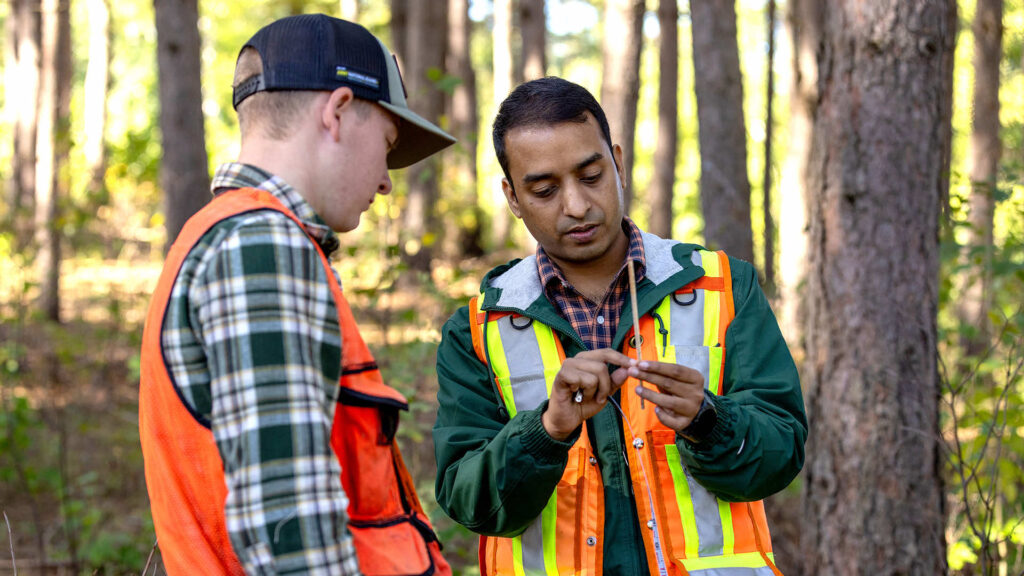
The grant will support a research project titled “Assessing Forest Readiness for Creating Efficient Biomass Supply Chains: Perceptions on Emerging and Innovative Technologies.” The project is led by Libin Thaikkattil Louis, assistant professor of forestry at UMFK and principal investigator, in collaboration with co-principal investigators Anil Raj Kizha and Adam Daigneault from the University of Maine School of Forest Resources.
The research will examine how emerging technologies can improve the production, harvesting and transportation of woody biomass while supporting healthy forest ecosystems and sustainable economic growth. Using long-term forest inventory data from across the Northeast, the research team will evaluate the economic and environmental impacts of forest biomass supply chains and develop strategies to improve their efficiency and sustainability.
The project comes as demand for renewable, forest-based materials continues to grow, increasing the need for research that balances forest productivity with long-term environmental stewardship.
“This award is a significant milestone for the University and a testament to the high-quality research being conducted by our faculty,” said Dean of Arts and Sciences Andrew Egan. “Our faculty’s leadership on this project highlights the strength of our forestry program and demonstrates that UMFK is making meaningful contributions to solving complex challenges facing the forest products industry.”
According to Louis, the project is designed to provide practical information for forest landowners, industry professionals and policymakers as the region transitions toward a more sustainable bioeconomy.
“Our forests play a vital role in supporting both the environment and the economy,” Louis said. “This research will help us better understand how emerging technologies can improve the efficiency of biomass supply chains while ensuring responsible forest management. By integrating ecological, economic and social considerations, we hope to provide stakeholders with the information they need to make informed decisions that support healthy forests and thriving rural communities.”
The grant includes funding for one master’s student and one doctoral student at the R1 UMaine strengthens UMFK’s forestry program by expanding faculty research and reinforcing the University’s reputation as a leader in undergraduate forestry education. UMFK offers both Associate of Science and Bachelor of Science degrees in Forest Management.
In addition to the newly announced USDA-funded project, other UMFK forestry faculty have also received grant awards.
Assistant Professor of Forestry and Wildlife Management Stéphanie Landry is the principal investigator on the research project, “Winter Tick Management: Protecting Maine’s Moose Population,” funded by the University of Maine System using State appropriation for the Maine Economic Improvement Funds, known as MEIF. The work will examine approaches to reducing the impact of winter ticks on moose health while supporting student involvement, partnerships, and broader benefits to Maine’s wildlife and natural resources.
UMFK Associate Professor of Forestry Neil Thompson serves as co-principal investigator on two Cooperative Forestry Research Unit-funded spruce budworm research projects launched in 2026: “Beyond the spray block: Natural enemy dynamics in spruce budworm early intervention” programs (Angela Mech, principal investigator, UMaine) and “An integrated landscape-scale monitoring and management framework for spruce budworm early intervention” (Adam Daigneault, principal investigator, UMaine). Together, these projects support research on biological control, landscape-scale monitoring, and early intervention strategies to help protect Maine’s forests from one of the region’s most significant insect pests.
UMFK President Deb Hedeen noted the extraordinary dedication of the UMFK faculty. “Our faculty are advancing transformative research while maintaining full teaching responsibilities. Their ability to excel in both is a defining strength of our university and benefits the student experience.”
For more information about the UMFK forestry program, visit the university’s website.